iGrant.io joins ETSI EAA Plugtests 2026 to validate EUDI Wallet interoperability
iGrant.io participates in the ETSI EAA Plugtests, validating EU Digital Identity (EUDI) Wallet interoperability across SD-JWT VC and ISO/IEC 18013-5 formats
Description
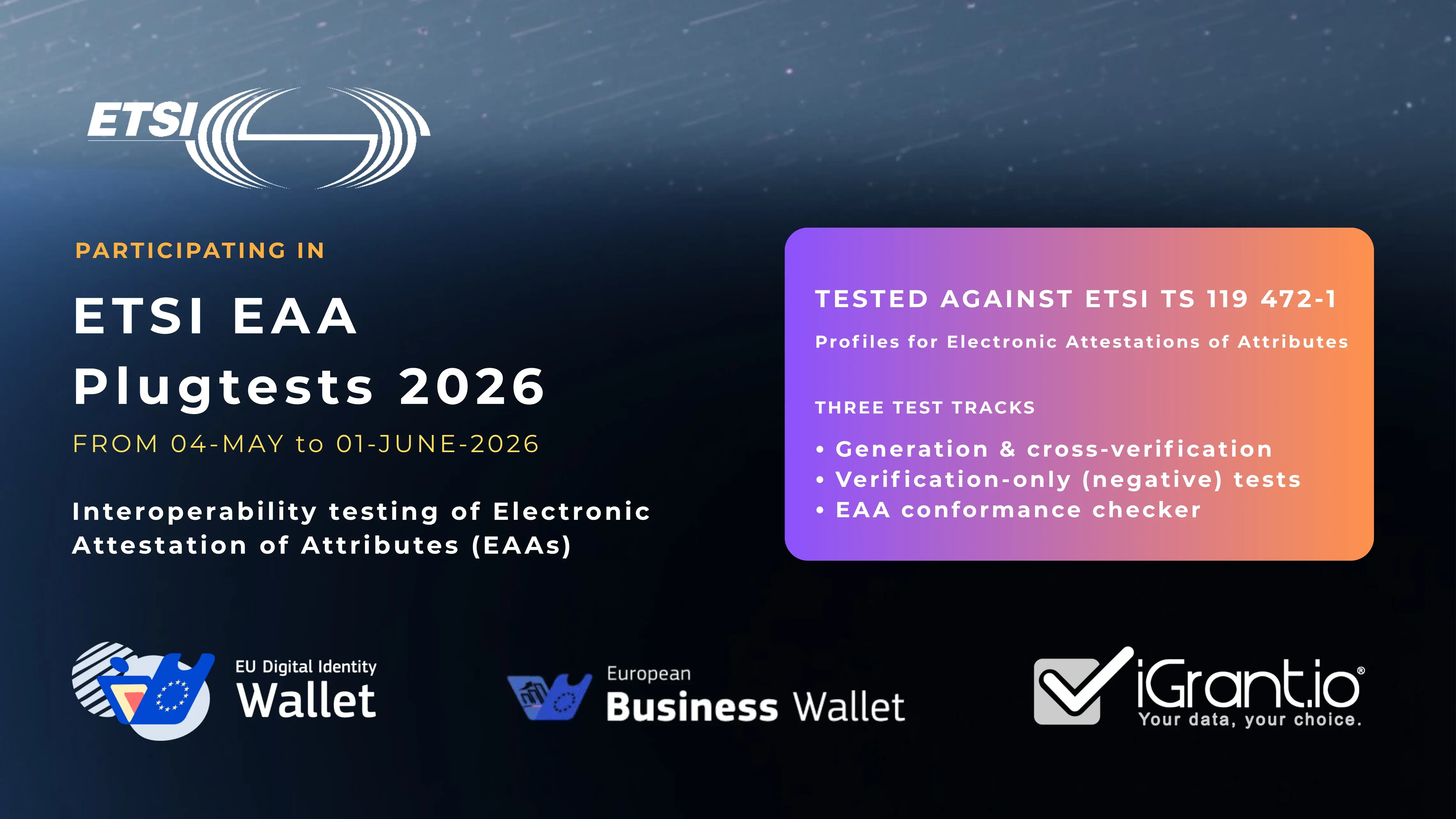
The ETSI Centre for Testing and Interoperability is running a Plugtests event on Electronic Attestation of Attributes (EAA) for the EU Digital Identity (EUDI) Wallet. The event verifies the interoperability of EAA, a foundational building block of the EUDI Wallet, by testing implementations against ETSI Technical Specification TS 119 472-1, with a focus on formats based on SD-JWT VC and ISO/IEC 18013-5.
Highlights of the session
- Session: ETSI EAA Plugtests 2026
- Dates: 4 May 2026 to 1 June 2026
- Location: Online
ETSI EAA Plugtests 2026 for testing EUDI Wallet interoperability
The 2026 ETSI EAA Plugtests run remotely from 4 May to 1 June 2026, bringing together developers, providers, and stakeholders working on Electronic Attestation of Attributes (EAA). The event tests implementations against ETSI TS 119 472-1 across three tracks: generation and cross-verification, verification-only (negative) tests, and EAA conformance checks.
Electronic Attestation of Attributes (EAA) is a foundational building block of the European Digital Identity (EUDI) Wallet and is highly relevant to European Business Wallet use cases. It enables structured, verifiable claims (such as age, professional qualification, authorised signatory status, or company registration status) to be issued, held, and verified in a trusted digital format. At the ETSI EAA Plugtests, iGrant.io participates in validating real-world interoperability and contributes to the practical validation of EUDI Wallet implementations.
Supporting developers during EAA integration
To support the wider EUDI Wallet developer community, iGrant.io maintains a free JWT/SD-JWT decoder and an mdoc CBOR decoder as part of its developer tools. The tools help developers inspect token headers, payloads, disclosures, and signatures during EAA and EUDI Wallet integration, as well as during plugtests and live events. They are designed to help teams debug, validate, and better understand wallet interactions when working with verifiable credentials and related trust infrastructure. Visit DevTools by iGrant.io for hands-on testing and decoding.
ETSI TS 119 472-1, together with SD-JWT VC and ISO/IEC 18013-5, maps directly onto these tools. Both formats are profiled in the EU Digital Identity Wallet Architecture and Reference Framework (ARF) under eIDAS 2.0 and its implementing regulations.
Why this matters for decision makers
The success of the EU Digital Identity Wallet depends on infrastructure readiness. iGrant.io helps create interoperable systems that connect Member States, public and private organisations, and citizens, anchored in standards-based digital identity. Over the coming months, the EUDI Wallet will be rolled out across the EU, and every wallet must communicate reliably with issuers and verifiers, whether the holder is a citizen, a professional, or a legal entity.
About iGrant.io
iGrant.io is a Swedish software provider of the Data Wallet (EU Digital Identity Wallet) and the Organisation Wallet Suite (EU Business Wallet), enabling individuals and organisations to securely and seamlessly manage, issue, verify, and share digital credentials. iGrant.io actively contributes to European digital identity initiatives and interoperability programmes advancing eIDAS 2.0-aligned wallet ecosystems.
Read how the EUDI Wallet is transforming customer onboarding across regulated industries.
Get started: download the Data Wallet for individuals and try our demo use cases.
Contact [email protected] for more information.